Thursday, July 5, 2012

Slouching Towards Bethlehem


      Slouching Towards Bethlehem is a collection of short journalistic stories with a glance into the innermost workings of an artist. When I was first introduced to this book (in my Writing About Places class), I was susceptible to viewing the world with wonder and now four years later, that mood has sprung on me again. People, places, things are remarkable. They have this incredibly long history. Even if they are brand new, there are years and years behind the making of any object. The world is really full of wonder and Joan Didion will help you realize that again and again.

     I used to love the perspective that my drawing classes used to give me. I would walk around examining the details of every thing my eyes rested on and it would just fill me with wonder and make me feel more intelligent for being able to notice the details. It makes you think of the whys. It makes you think of how great the world is. It just makes you think of the good in the world, which is always a helpful attitude.

     Joan Didion is similar to Virginia Woolf because reading them comes with moods, a particularly dreamy one where you just want to sit and think and write. With Joan it is a dreamy mood about the past. Like she states in "Notebooks," about keeping tidbits of other people's conversation, it always ends up being autobiographical. It ends up reminding you of your emotions, thoughts, what you where doing at the place, and why you were there.  It inspired me to write, to think about my past experiences at worthy stories that someone else would benefit from. It aggrandized my memories because she created that atmosphere with hers. Really, I wanted to write about all the places I had been, about where I grew up (am still growing up), about the essence of all the things I experienced. So, in my book this is a worthy inspiration to have around.


     With the otherworldly mood comes descriptions and insights into places I have never been. Places that seem insignificant until she wrote about them and then you begin to cherish all your experiences as something bigger and important to the world. She gets to the essence's core. She describes Hawaii (somewhere I have never really desired to go) with special attention to the past and with emphasis on how war permeates many aspects of the place.

     Of course, when discussing this book, one has to go over the Haight Asbury district during the 60's. "Slouching Towards Bethlehem" was not as penetrating as her other pieces. It was also my second time reading it, so some of the wonder had faded. Honestly, that is just not a time or movement I have much interest in. I never knew about that particular place full of the dejected rebels until my Writing About Place class that really opened my eyes to the wonder in the world and how absolutely interesting everyone is, even the ones with the same background as me (although, those were no where to be found in that class room full of eight very distinct people). She very much embodies the time this book was written, the late 60's. She doesn't just cover the stereotypical hippies, but many aspects of that life, especially that of the West.

     She writes accurate accounts about murderers like it is a fictional short story.

     Didion is able to pierce into the very motivation of the person she is studying. This gives her an omnipotent super power: the ability to understand a person. I mean truthfully understand why they act a certain way, without any meanness. No matter if it is a murderer or a communist, she is able to explain their motivations and reasons to where we all call relate. To where we have all been before.

      In one passage in "On Keeping a Notebook," Didion writes about how she remembers certain stories differently from the other people that were there, too. This is an ongoing realization that our minds re-remember events. Each time we pull up a memory from the brain shelf, we remember it again with whatever new perspective we are at in life. This is part of the beauty of realizing that we are fallible, that our minds are not perfect, that we can make up stories and who cares if they are not completely accurate, it's our memories, our reality. So, what if my mind is trying to suppress something bad or embarrasing, that memory has all ready been dealt with and I have all ready learned from it, so who needs it anymore, anyway? Right now, I am just going to enjoy who I am.


Quotes

"It was the first time I had dealt directly and flatly with the evidence of atomization, the proof that things fall apart.."

"I suppose almost everyone who writes is afflicted some of the time by the suspicion that nobody out there is listening, but it seemed to me then (perhaps because the piece was important to me) that I had never gotten a feedback so universally beside the point."

"...there is always a point in the writing of a piece when I sit in a room literally papered with false starts and cannot put one word after another and I imagine that I have suffered a small stoke, leaving me apparently undamaged but actually aphasic."

"...the revelation that the dream was teaching the dreamers how to live."  These dreamers imagine such a life and such a way of living, that they become more like their dream in trying to achieve it than themselves. It is like the saying "fake it till you make it." If you do something long enough it become part of who you are without you realizing that your are changing to fit into a mold.

"...an assembly of the very peers — housewives, a machinist, a truck driver, a grocery-store manager, a filing clerk — above whom Lucille Miller has wanted so badly to rise. That was the sine, more than the adultery, which tended to reinforce the one for which she was being tried [murder]."

"And in a world we understood early to be characterized by venality and doubt and paralysing ambiguities, he [John Wayne] suggested another world, one which may or may not have existed ever but in any case existed no more: a place where a man could move free, could make his own code and live by it; a world in which, if a man did what he had to do, he could one day take the girl and go riding through the draw and find himself home free, not in a hospital bed with the flowers and drugs and the forced smiles, but there at the bend in the bright river, the cottonwoods shimmering in the early morning sun."

"Joan Baez was a personality before she was entirely a person, and, like anyone to whom that happens, she is in a sense the hapless victim of what others have seen in her, written about her, wanter her to be and not to be."

"They worry a great deal about 'responding to one another with beauty and tenderness."'

"...the general look of a man who has, all his life, followed some imperceptible but fatally askew rainbow."

On a shot gun wedding in Vegas: "But Las Vegas seems to offer something other than 'convenience'; it is merchandising 'niceness,' the facsimile of proper ritual, to children who do not know how else to find it, how to make the arrangements, how to do it 'right."'

"Adolescents drifted from city to torn city, sloughing off both the past and the future as snakes she their skins, children who were never taught and would never now learn the games that had held the society together."

"See enough and write it down, I tell myself, and then some day when I am only going through the motions of doing what I am supposed to do, which is write -- on that bankrupt morning I will simply open my notebook and there it will all be, a forgotten account with accumulated interest, paid passage back to the world out there..."

Since I just finished Crime and Punishment and the review is coming up next: "I had somehow thought myself as kind of academic Raskolnikov, curiously exempt from the cause-effect relationships which hampered others."

"There is a common superstition that 'self-respect' is a kind of charm against snakes, something that keeps those who have it locked in some unblighted Eden, out of strange beds, ambivalent conversations, and trouble in general. It does not at all."

"Nonetheless, character -- the willingness to accept responsibility for one's own life -- is the source from which self-respect springs."

"People who respect themselves are willing to accept the risk that the Indians will be hostile, that the venture will go bankrupt, that the liaison may not turn out to be one in which Every day is a holiday because you're married to me. [that needs to be in italics] They are willing to invest something of themselves; they may not play at all, but when they do play, they know the odds."

A bit of advice I myself have used on numerous occasions to calm myself down: "It was once suggested to me that, as an antidote to crying, I put my head in a paper bag. As it happens, there is a sound physiological reason, something to do with oxygen, for doing exactly that, but the psychological effect alone is incalculable: it is difficult in the extreme to continue fancying oneself Cathy in Wuthering Heights with one's head in a Food Fair bag." All I have to do is remember the Cathy part and that calms me down. I haven't tried the paper bag, yet.

"To have the sense of one's intrinsic worth which constitutes self-respect is potentially to have everything.."

Thursday, June 28, 2012

Virginia Woolf Phase


Wikipedia. Image of the first edition cover.

      This is Virginia Woolf's first novel and it is a ringer. She touches the core endeavor of existence: the struggle to communicate. She is like a modern Jane Austen, except she is dreamier and she goes deeper into life truths.

     This naive girl of twenty-four (because let's face when you are that lost and out of touch, no matter what your age is, you are still a girl) is traveling on a cargo ship with her father, aunt, uncle, and a family friend. Along the voyage they pick up some people that influence her very quickly and easily, but leave her with a bad taste in her mouth because they turn out to be shadows of real people. The aunt realizes that she is uncultured and persuades Rachel to stay with her for the winter season on this tropical island. This is where Rachel begins a romantic relationship with another vacationer. It starts out apopriately with an excursion to the top of a mountain and solidifies on another trip. The relationship begins with them just enjoying each others company with no thought to love or marriage, which is a lovely contrast to out society where everyone seems to be looking for a one night stand or to find "the one" in every relationship. It is beautiful how it starts out so clueless and progresses into a fabulous awakening to love.

Goodreads has another recap of the book and is a great place to share what you are reading with friends.

     The two lovers quickly realize how separate and individual they are and how hard it is to truly know another person because the limits of communication. 

"Near though they sat, and familiar though they felt, they seemed mere shadows to each other."

      It is easy to think you know someone, but they will always be able to surprise you. All it takes is one comment you did not expect to come out of their mouth and there is the surprise. In the book, the lovers begin to get to know each other and gradually realize how hard it is to understand someone and how difficult it is to tell someone your thoughts and feelings. I don't believe that it is language's fault. It is just the struggle to understand another person, to put yourself in their perspective, to tell the truth. 

     Besides not being able to fully know another person, there is all the emotions that have to be swept aside before you can attempt to enter another person's thoughts and even then you always see things through your own reality. We are never able to truly see through another perspective because we are always stuck in our own. There is a different between your perspective and walking a mile in another's shoes. The first is like entering another dimension. The second is imagination and context clues. Our own perspective tints everything that we do, so it is difficult to enter into another's thoughts and feelings. Authors are able to step into another person's mind, but they never leave their own reality.  Authors are also inventing their book's reality. They reference the real world, but a lot of fiction writers make it up.

     But that is a phillisophical debate along the lines of "do objects exist when we are not around?" One would think that the immediate answer would be, "yes," but can something exist outside of our own reality? I think things do exist when we are not around just because they are in our reality. A plant is still going to be in the same place and grow when one is not around, but without one's perspective it would not exist. Therefores, we can never truly leave our own perspective, because there is no way to know any other.  
Source  
     
     As I was writng this review, I thought to myself, "I need to work on expanding the difficulty of communication part in my post," and then I realized that I was a perfect example of this struggle and how beautiful that was. It's wonder full (spelled that way on purpose to emphasize how full of wonder something is) because it will always be a problem so at some point, there is no need to worry about it. We have arrived at the best solution and their is no need to lament the fact that perfect communication is unreachable. This realization comes back to me everyday when there is a misunderstanding in conversation.  As soon as I realize the problem, it makes me want to work harder to convey my thoughts, so really it is a helpful solution when you understand that most anger comes from misunderstanding (or stupidity which could also be a misunderstanding) which can be explained better or from a different perspective. At first, I lament the fact that communicating is so hard but then I think, "I can do better than this," and that spurrs me on to try again.

It is one of the many life lessons and truths that will haunt the reader after this dreamy, captivating book is finished with a certain relish that rarely happens. 

The Virginia Woolf Blog.


Quotes

""That's what comes of putting things off, and collecting fossils, and sticking Norman arches on one's pigsties.""

"...'sentimental,' by which she meant that he was never simple and honest about his feelings."

"Her mind was in the state of an intelligent man's in the beginning of the reign of Queen Elizabeth; she would believe practically anything she was told, invent reasons for anything she said. "

"To feel anything strongly was to create an abyss between oneself and others who feel strongly perhaps but differently."

"Let these odd men and women—her aunts, the Hunts, Ridley, Helen, Mr. Pepper, and the rest—be symbols,—featureless but dignified, symbols of age, of youth, of motherhood, of learning, and beautiful often as people upon the stage are beautiful. It appeared that nobody ever said a thing they meant, or ever talked of a feeling they felt, but that was what music was for."

"'That's the tragedy of life—as I always say!' said Mrs. Dalloway. 'Beginning things and having to end them.'" 

"The vision of her own personality, of herself as a real everlasting thing, different from anything else, unmergeable, like the sea or the wind, flashed into Rachel's mind, and she became profoundly excited at the thought of living."

"Rooms, she knew, became more like worlds than rooms at the age of twenty-four."

"'It's the facts of life, I think—d'you see what I mean? What really goes on, what people feel, although they generally try to hide it? There's nothing to be frightened of. It's so much more beautiful than the pretences—always more interesting—always better, I should say, than that kind of thing."'

"They had the appearance of crocodiles so fully gorged by their last meal that the future of the world gives them no anxiety whatever."

"'Why is it that they won't be honest?' he muttered to himself as he went upstairs. Why was it that relations between different people were so unsatisfactory, so fragmentary, so hazardous, and words so dangerous that the instinct to sympathise with another human being was an instinct to be examined carefully and probably crushed?"'

"'I like walking in Richmond Park and singing to myself and knowing it doesn't matter a damn to anybody. I like seeing things go on—as we saw you that night when you didn't see us—I love the freedom of it—it's like being the wind or the sea."'

"All round her were people pretending to feel what they did not feel, while somewhere above her floated the idea which they could none of them grasp, which they pretended to grasp, always escaping out of reach, a beautiful idea, an idea like a butterfly. One after another, vast and hard and cold, appeared to her the churches all over the world where this blundering effort and misunderstanding were perpetually going on, great buildings, filled with innumerable men and women, not seeing clearly, who finally gave up the effort to see, and relapsed tamely into praise and acquiescence, half-shutting their eyes and pursing up their lips." 

Virginia and Vanessa, her sister.
"'I make it a rule to try everything,' she said. 'Don't you think it would be very annoying if you tasted ginger for the first time on your death-bed, and found you never liked anything so much? I should be so exceedingly annoyed that I think I should get well on that account alone."'

"'You see that things are bad, and you pride yourself on saying so. It's what you call being honest; as a matter of fact it's being lazy, being dull, being nothing. You don't help; you put an end to things."'

"Nevertheless, they remained uncomfortably apart; drawn so close together, as she spoke, that there seemed no division between them, and the next moment separate and far away again."

"In solitude they could express those beautiful but too vast desires which were so oddly uncomfortable to the ears of other men and women—desires for a world, such as their own world which contained two people seemed to them to be, where people knew each other intimately and thus judged each other by what was good, and never quarrelled, because that was waste of time."

"Nor were people so solitary and uncommunicative as she believed. She should look for vanity—for vanity was a common quality—first in herself, and then in Helen, in Ridley, in St. John, they all had their share of it—and she would find it in ten people out of every twelve she met; and once linked together by one such tie she would find them not separate and formidable, but practically indistinguishable, and she would come to love them when she found that they were like herself."

"...she thought how often they would quarrel in the thirty, or forty, or fifty years in which they would be living in the same house together, catching trains together, and getting annoyed because they were so different. But all this was superficial, and had nothing to do with the life that went on beneath the eyes and the mouth and the chin, for that life was independent of her, and independent of everything else. So too, although she was going to marry him and to live with him for thirty, or forty, or fifty years, and to quarrel, and to be so close to him, she was independent of him; she was independent of everything else. Nevertheless, as St. John said, it was love that made her understand this, for she had never felt this independence, this calm, and this certainty until she fell in love with him, and perhaps this too was love. She wanted nothing else."

"There was undoubtedly much suffering, much struggling, but, on the whole, surely there was a balance of happiness—surely order did prevail."

Thursday, June 21, 2012

My sort

  
My Goodreads account.


      When buying A Writer's Diary by Virginia Wolf, I knew that I would fall in love with it. Virginia (we are on a first name basis after how much I learned in this book. She's a soul mate) just speaks to me on every level. Her books bring me to the ground and raise me to the clouds. It is poignant, diligent, lovely, painful, and insightful. She uses her diary as a writing exercise describing people with precision, digging down into their deepest characteristics, illustrating nature with poetry, and working out problems with her books.

     Even though the chapter headers name the years, it felt like I was reading a contemporary (except for the war part anyway). Her diary is not dated, her struggle is every writers. It is shocking how 70 years difference does not exist. This was just her diary, her free thoughts and they are still incredibly relatable. I learned many lessons reading this book and wished for more. This is just another example of how books are able to transcend time and place.  Books teach you something no matter if you realize it or not: the structure of grammar, new perspectives, how to communicate, life lessons, ultimate truths, the power of love. They increase your imagination and work your mind. it's always good to read a book.

Link.
      The book is culled from five volumes of her diary. It is mainly the references to her writing, exercises, and the struggle. The book ends four weeks before she commits suicide and I was struck by how normal it all was. She was not even at her lowest point, but it was not a portrayal of the emotional Virginia but the writing one and it is assumed by popular culture that she committed suicide because of her struggle with writing, the problem of communicating ideas. But, of course, we will never be able to know the real reasons. I was still surprised by the normalcy of her writing in the last few weeks of her life. She is so driven, so observant, and appreciative of her writing, that is is sad to think in a mere four weeks she will no longer be able to write anymore. It was her solace and fortress against the world.

     She writes about the ebb and flow of her writing, the weather, what she sees that was remarkable that day only because she made it so with her words, of people and their inner workings, of the struggle and glory of writing, what she had recently read and the character on the author. She makes all other diaries seem superficial and admonishes herself because she thinks she is being superficial. It is inspiring, making you want to write and follow exactly how she went about her day just to gain a drop of her genius. She turns the simple weather into lyrics and insights.

     This book just reiterates the struggle to grasp words in a tall tree, the attempt of understanding between people.

     My words do not do her's justice and I wish they did. Whether you are a reader, a writer, or a lover of beauty, read this, cherish this. It will do you good.

Virginia and Clive Bell at the beach and a article about their relationship.


Quotes

"If I thought and took thought, it would never be written at all; and the advantage of the method is that is sneaks up accidentally several stray matters which I should exclude if I hesitated, but which are the diamonds of the dustheap." So, just write and edit later. A method she only partially followed herself, but a good way to just get it all out.

"Yet, if one is to deal with people on a large scale and say what one thinks, how can one avoid melancholy?" People can be melancholy creatures and if you are down on the world, it will seem like everyone is awful. This may seem drastic, but we have all been there and this allows us to appreciate the small sparks of intelligence and beauty.

"Unpraised, I find it hard to start writing in the morning; but the dejection lasts only 30 minutes, and once I start I forget all about it. One should aim, seriously, at disregarding ups and downs; a compliment here, silence there;... the central fact remains stable, which is the fact of my own pleasure in the art."

"In the first place, there it [Night and Day] is out and done with; then I read a bit and liked it; then I have a kind of confidence, that the people whose judgement I value will probably think well of it, which is much reinforced by the knowledge that even if they don't, I shall pick up and start another story on my own."

"I don't take praise or blame excessively to heart, but they interrupt, cast one's eyes backwards, make one wish to explain or investigate."

"Unhappiness is everywhere; just beyond the door; or stupidity, which is worse."

On analyzing a book: "'Ah, you're my sort"--a great compliment. Most people who died 100 years ago are like strangers. One is polite and uneasy with them." And the world comes full circle as I call Virginia "my sort."

"The way to rock oneself back into writing is this. First gently exercise in the air. Second the reading of good literature. It is a mistake to think that literature can be produced from the raw. One must get out of life...one must become externalized; very, very concentrated, all at one point, not having to draw upon the scattered parts of one's character, living in the brain."

"It is a general sense of the poetry of existence that overcomes me."

"Arnold Bennett said that the horror of marriage lies in the 'dailiness.' All acuteness of relationship is rubbed away by this. The truth is more like this: life -- say 4 days out of 7 --becomes automatic; but on the 5th day a bead of sensation (between husband and wife) forms which is all the fuller and more sensitive because of the automatic customary unconscious day on either side"

"I don't believe in aging. I believe in forever altering one's aspect to the sun."

"Odd how the creative power at once brings the whole universe to order."

"I mean in having a mind that can express -- no, I mean in having mobilized my being -- learnt to give it complete outcome -- I mean, that I have to some extent forced myself to break every mold and find a fresh form of being, that is of expression, for everything I feel or think. So that when it is working I get the sense of being fully energized -- nothing stunted. But this needs constant effort, anxiety and rush."

"...and Swinnerton's sneers and Mirsky's -- making me feel that I'm hated and despised and ridiculed -- well, this is the only answer: to stick to my ideas. And I wish I need never read about myself or think about myself, anyhow till it's done, but look firmly at my object and think only of expressing it. Oh what a grind it is embodying all these ideas and having perpetually to expose my mind, opened and intensified as it is by the heat of creation, to the blasts of the outer world. It I didn't feel so much, how easy it would be to go on."

"I've been thinking about Censors. How visionary figures admonish us...If I say this, So-and-so will think me sentimental. If that...will think me bourgeois. All books nor seem to me surrounded by a circle of invisible censors."

Thursday, June 7, 2012

Autobiography of Bevenuto Cellini

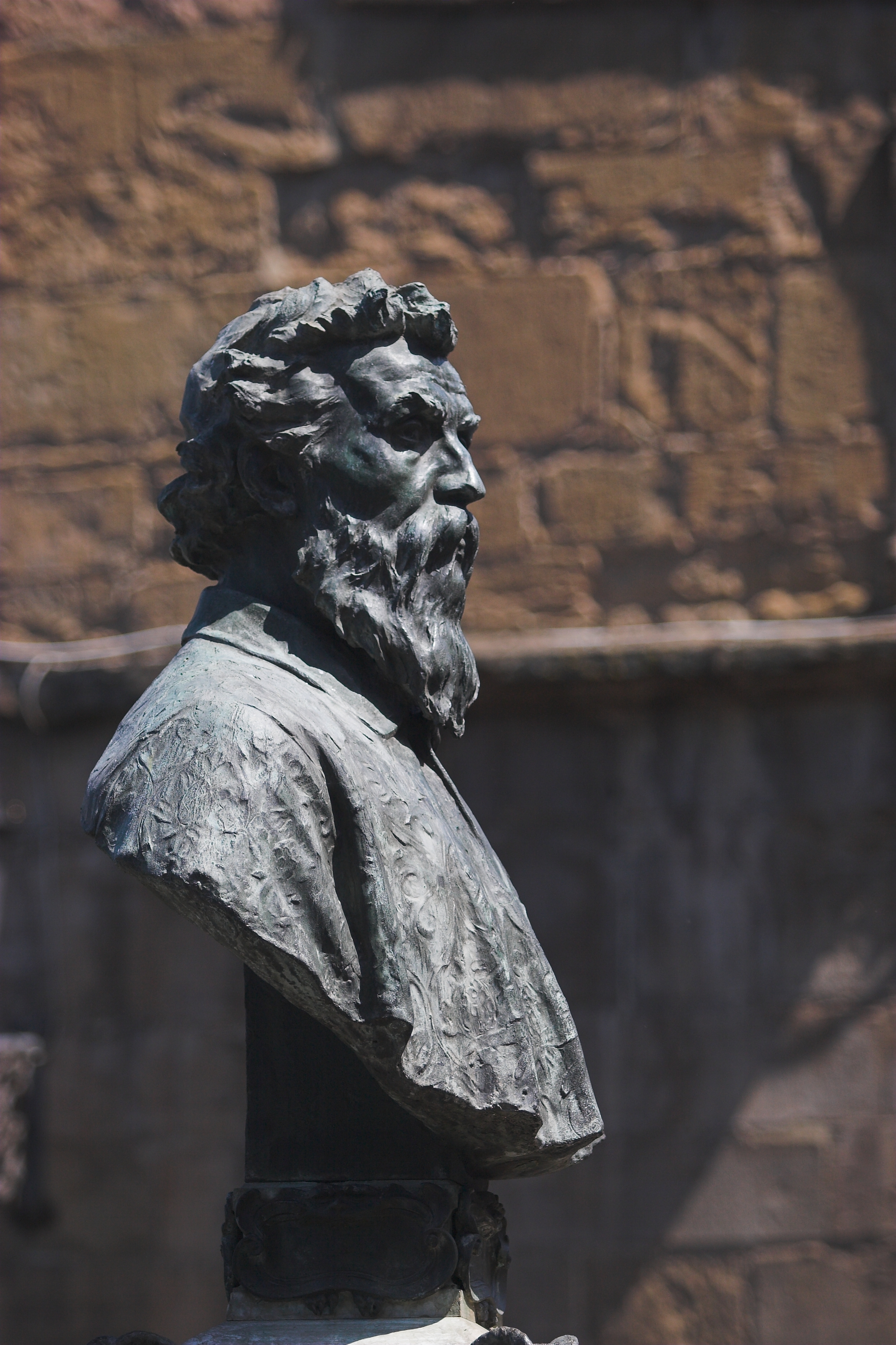
Bust of Cellini

       Instead of reading this book I listened to it through this cool app (Audiobooks, the free ones are classics in the public domain) that lets me listen to free audiobooks read by volunteers. Normally, I am all about actually reading the book, but for an extremely long, braggy autobiography with not much deeper philosophy, I think it is okay to just listen to it (plus, I'm strapped for time and I want to read, dang it). For example, I started to listen to Virginia Wolf's The Voyage Out and quickly stopped because I was not soaking in the beauty of her words. Now, any general novel that is an interesting story, has life truths, and/or insights would be fine in audiobook form. If the book is meant for the reader to fall into and just enjoy, an audiobook is a good way to multitask and still get the marrow out of the book. The wonderful aspect of audiobooks is that you can drive and listen and do other things while listening to a book. Multitasking is something that I love. I am always wishing I had more time to read the many, many transcending books out there and audiobooks give me that chance.

Crucifixion
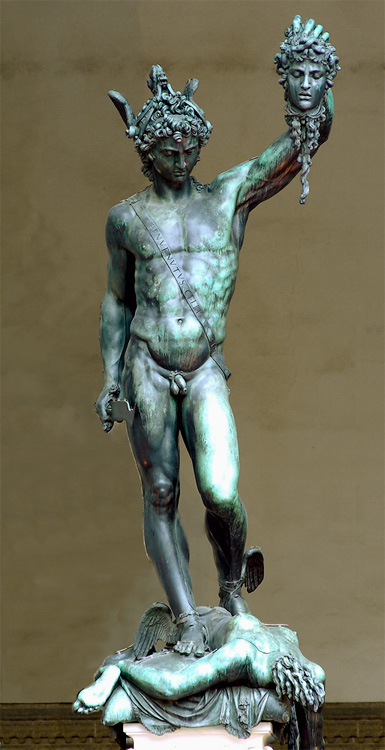
     Before I started the book, I knew that Cellini was a dastardly fellow, that he had murdered several people in his lifetime and bragged about it in his autobiography. I wanted to read this  because he was an artist during the late Renaissance and that is my art historical area of focus, so I knew that it would give me insights into how an artist lived and worked during the times. Now, I hope that some of the more salacious stories told are exclusive to Cellini. He brags about his artworks, not just describes them but lauds them (according to him, his artworks are better than any that came before and done in an entirely new way every time, even exceeding the ancients while mimicking them). He blames all his murders on self defense and the other person wronging him. He boasts about the praise given to him by his employers and other people and calls anyone who does not like him an evil fellow. All in all, he is a rather bad man, but his autobiography is an important historical document to a time long past and a rather interesting read because of all the crimes and angry outbursts.
    
     This book brings up the relationship between the patron and artist when artists were mere laborers. Cellini is often at the mercy of some powerful patron (pope, king, or rich person) much to his chagrin. For most of his life, he is not free to create what he wants. He has to create what the patron decides the subject matter should be and he never complains about it because that was the accepted method. After the subject matter is chosen, the artist is free to add his own style to it and this turns out to be very successful for Cellini according to his gloating. Numerous times, Cellini has to ask his patron if he can leave or travel, which is vastly different from the image of the wild and free artist of today. Cellini was definitely wild: he had a dangerous temper if crossed, but he was a social artist, wanting to please his patron at all times. This book highlights the different relationships and image of an artist from then to now, which allows for a comparison and for a more penetrating understanding.


Perseus with the Head of Med
       Based on my own art historical research (I wrote my undergraduate thesis on competition between Leonardo and Michelangelo), the Renaissance was an atmosphere filled with rivalries. It is only really remarkable when you think of artistic relationships today. Yes, there are certain spiteful relationships, but most artists appreciate what others are doing. They do no try to tear each other down. During the Renaissance, they encouraged competition between competent artists and this could create a hostile atmosphere to create art, which is strange considering how beautiful and idealistic most of the art was (yes, there was monsters from mythology and depictions of Christ on the cross, but most of the people were depicted idealistically, choosing the best features and putting them all together).  There were less opportunities: fewer successful artists, fewer patrons, they all had to be formally trained and part of a guild before they could make money off of their art. This competitive nature may not apply solely to the Renaissance, but it is in definite contrast to what is going on now and a nice thought that we have partially put nasty rivalries behind us.

     This is also about memory and how it is subject to time. Not because Cellini was necessarily wrong in his recollections, biased, or trying to hide something, but because all memories are slanted and subject to change (he probably was trying to hide something or biased towards himself, though). Memories are not just recordings of what happened. They are re-remembered each instance, time plays tricks, and we are ever changing so even our opinions of our memories alter. No group of people will remember an event they were all at the same. Memory is a wonderful and fickle tool.
Salt Cellar
     Cellini is very famous for his autobiography and for what a rascal he was. The only artwork I remember of Cellini's is the salt cellar (which having a B.F.A. in Art History and focusing on the Renaissance it is impressive that I have never heard of any of his other artworks). That is a testament to his writing prowess and his storytelling capabilities. He did lead an interesting life with many adventures, fights, tribulations, travels, famous people, and powerful mortals. Besides the art historical, historical, and literary benefits, this autobiography reiterates that the past is a pope's treasure of life lessons. By learning from past people's mistakes, we can avoid them in our own lives and just expand our horizons.


All images taken from Wikipedia.

Thursday, May 31, 2012

Down the Rabbit Hole

Source Goodreads
Who better to illustrate Alice in Wonderland than Salvador Dali?
Alice in Wonderland and Philosophy: Curiouser and Curiouser is a beautiful insight into the seemingly nonsense of Lewis Carroll's classic children's book, Alice in Wonderland. It is a collection of articles from numerous philosophers that all take a trip down the rabbit hole to shed some light on this childhood fantasy. You don't even have to be an avid lover of Alice in Wonderland to enjoy what these brilliant minds are doing: pulling logic from curious stories and turning them into greater truths about life. The subject matter ranges from feminism, to nuclear strategists, to drug use, to procrastination, to logical lessons, to what's reality, to language and etc. Oh, and there is also mention of the Spice Girls, which is enough to bring this Posh Spice imitator back to Wonderland in a hurry.


Down the Rabbit Hole
The (good and bad) problem is that many of the authors hit upon the same stories repeatedly. I am pretty sure everyone mentioned going "down the rabbit hole" (and really my mention was a slight sarcastic nod of appreciation to the writers). They all had different perspectives on the same few stories, which is a good way to learn and open your mind. It is a testament to human diversity that one passage can bring so many different interpretations.

       I was in love by the first chapter which is about Alice being a feminist. The writer is also a teacher and she gave her class the assignment of discussing their favorite unruly fairy tale heroine. Alice was chosen by two students and this prompted the author to contemplate the feminism of Alice. Without all the logic jargon, Alice is truly her own person. She goes where she wants to, does what she likes, and ultimately takes control of the situation (her proclaiming that they were "only a deck of cards" and stating that she could control her own dream), despite being a girl in a strange world. Which turns into a great lesson: you are in control of your life.

The Rabbit Sends in Little Bill
     Alice's story being just a dream leads to the question of what is reality. Is it just our perspective or does life go on even when we are not around? You'll have to read the articles and form your own opinion, because they both give some pretty convincing evidence and that's a larger argument in the philosophic world that I don't want to paraphrase from reading a few articles. But it is worth dipping into in the context of Alice's highly amusing and silly story.

     The nuclear strategists article is fascinating to see the connections made (I bet you just know it is about the Red Queen), but because I am not a nuclear strategist, it did not have much resonance for me. The connections though, teach us about another level of creativity and knowledge. Steve Jobs said that creativity is just making the right connections and having a broad sense of knowledge, so you never know when this knowledge will come in handy for your next creative endeavor.    

     As far as philosophy books go, this one is written for the general public and the authors truly have fun with the subject matter, while taking it to a whole new level for the reader.

The idea of this book is brilliant because it takes this crazy little children's book and turns it into a book full of life lessons and revelations. Examples: Alice is a strong female lead character to look up to, that things are not always what they seem, that you should question things, keep an open mind, adapt to reality, think logically, do not judge based only on your perspective. You'll learn to think deeper about nonsense.

     Alice's trip down the rabbit hole is the ultimate life lesson: take the jump, go for it, try something new, and take a peak at a new perspective.

Advice from a Caterpillar
    

The Mad Tea Party (and my desktop background)


Thursday, May 24, 2012

Germinal

My Goodreads.


Summary that gives away some things, but not the big ones.

     Germinal by Emile Zola is a tragic story of mine workers barely surviving and working harder each day more than most people do in a year. This book is set in the late eighteen hundreds in rural France.  It is about a starving man searching for work, starting work at the mine, starting a strike, and leaving as the strike ends with no improvements. It is a story about indignation and the pursuit of justice/equality. It is also undercut with a love story that may never be realized, but it is certainly not the main aim of book (unlike most fiction ad movies nowadays). Zola mainly presents Etienne's perspective, but he also lets the reader into the lives of other miners, the managers, and the lazy rich. This allows the reader to see many points of view and shows the intricacies and problems of class separation. Although it shows some of the problems that stop the miner from living comfortably, it also makes you dislike the rich because they blame the poor wretches for their plight when they really have no other option but to live in poverty. They work hard and do not get the pay off, whereas, the rich barely work and do get the pay off.      After two months of starving and begging for food, the strikers become violent for a day, then the army gets called in, and they settle down into peace until foreign workers are brought to work their mine. The miners become violent again and the result is death for many of them, but the event becomes a national tragedy that finally forces the board members to settle the strike. They do this by posting sighs that say if the workers go back to the mine, they will start to review their grievances. The miners return to work and nothing changes. Their wages are still cut just like before and their lives are just as hungry. But hopefully, the seed of revolution was planted and change will come. The miners are resigned to the fate for the time being. 
     This was an incredibly depressing book that is worth the read because it is written by Zola, it will open your eyes to the class injustice of the past, and make you appreciate how equal life is now. I would check this out of the library, it's not a story that compels one to read again (unless you love Zola and are into the working man's plight).

Contemporary Cultural Relevance

With the Occupy movement protesting against the control the 1% has, this just goes to show that history repeats itself: the rich are still in control. Life is better, there are rules protecting workers now, there is welfare for the poor, and everyone has a chance at education, but the rich are still running the world. This book shows how far humanity has come and how far we have to go.

Life Lessons

"When a man had a woman in his heart, the man was finished, he might as well die."


Thursday, May 17, 2012

"Silence is for bumping into yourself."


       From the pursuit of absolute silence, to why we hear, to why we make noise, to what we are doing about noise, and to the middle ground of noise and silence that produces a little more quiet each day, is just a sample of the myriad of subjects covered in George Prochnik's In Pursuit of Silence.  During his pursuit of silence, the revelation came when absolute silence produces more noticeable noises. Because of the wish for silence and because of silence, the slightest noise is amplified, creating annoyance for the pursuer.  That is something I acutely noticed while reading this book. I could not have any noise going, but what was absolutely deemed necessary by me (like the air conditioner in a torrid southern climate). Anytime someone intruded upon my silent cone, I had to search for the calm again. This book will make you more aware of the danger of noise throughout your daily life.
      The realization that silence equals wisdom comes as an early ah-ha moment. You've always know that quiet is where ideas and revelations appear, but understanding that quiet is the best place to flesh out ideas because there is little to distract the thinker. Other people may be able to listen to music and multitask while thinking of ideas, but the best way to get to the bottom of something is in quiet.
 "...our brains are always searching for closer. When we confront silence, the mind reaches outward."
He looks at the solutions to noise and they are mostly about subduing it, not trying to solve it.
"...what happens when we try to create complete soundproofing: somebody ends up getting smothered. Their gasps for air will grow louder and louder until we surrender the fantasy of total noise control. Because, in the end, we are born into this world screaming as loud as out tiny lungs can howl, yet simultaneously terrified of loud sounds and demanding silence in order to sleep."
      Prochnik even takes it so far as to examine what the government is doing to regulate noise.  Which makes this a well rounded examination into most of the perspectives of silence. The only question I had about the book is why he explored boom cars as one of the most extreme examples of noise making.  It is just not clear why he choose that particular form of noise making when there are so many others and why exactly he did not look into other examples of extreme noise. That is the only thorn in my foot about this book. Yes, some of the sections on how your brain works and how your ears work are a little boring, but that is my personal aversion to learning about the inner workings of my body. (It gets me all tingly).
     Ultimately, his solution to noise is to educate the public on the harmfulness of noise and the benefits of silence while creating more places in urban environments where you can enjoy peace and quiet. 
     This books main theme is the pursuit of quiet, not silence. In quiet we can hear the birds singing, the wind blowing through the trees, and the steady flow of traffic, just to be reminded that the world is full of wonder.  Silence often leads to noticing more annoying noise, but quiet allows you to hear all the normal noises at a low level, just perfect for getting things done.
Anyway, enjoy this book, savior it in silence, and just appreciate the quiet.
 
Quotes
"The pursuit of silence, likewise, is dissimilar from most other pursuits in that it generally begins with a surrender of the chase, the abandonment of efforts to impose our will and vision on the world."

"...the larger idea of silence as a break, a rest, a road to reflection, renewal, and personal growth is one that resonates with many people."

"...the problem was that without silence people had no ability to understand one another."

"Even brief silence, it sees, can inject us with a fertile unknown: a space in which to focus and absorb experience -- a reminder that the person we are with may yet surprise us; a reflection that some things we cannot put into words are yet resoundingly real; a reawakening to our dependency on something greater that ourselves."

"Indeed, if there's nothing else to hear, at a certain point our own ears will often begin to make sound."

"...noise is sound that makes us, for the time it's there, cease to distinguish between the beings and objects outside us. Noise enables us to forget the larger world."

The Beginning

      The nickname Goddess came from a drunken rant by the same guy who introduced me as not a donator to charity even though that's my name. He was disappointed in women, drank too many Jack and cokes, and I was the only female at his pity party. We were at this imaginative place called Mr. Pizza, which was one of three places you could eat late in Savannah and it was close to our dorms. He was saying that all women were so lame and then he looks at me and says, "Except you. You're like a goddess." Best compliment ever?! And then that started a whole thing of having worshipers and who was the best and well it still gets mentioned in a lot of catch up text messages.
     Charity is my name and Goddess is my nickname and charity is a wonderful attribute to preside over. Goddesses did not always live up to their attributes, so I don't necessarily have to talk about love, but I am going to discuss my love for books and other amazing things.
     But first here is an example of Goddesses not being very nice. There was a competition of who was prettier between Aphrodite, Hera, and Athena, and they turned to a man named Paris to judge the competition because he was said to be an excellent appraiser of beauty. All the goddesses offered him different things if he chose her. Hera promised to make him king of Europe and Asia, Athena promised that the Trojans would win against the Greeks, and Aphrodite promised that the prettiest woman in the world would be his. He picked Aphrodite's bribe and that lead to the Trojan War.

This movie isn't the most amazing, but it tells the story pretty well. Image source
      The goddesses started by fighting with each other and ended with fighting, when they really should have just said, "Screw it. We are GODDESSES! We do not need some mere mortal telling us who is hotter. We are all beautiful." That really would have been the better moral, but those Greeks were all drooling for the gossip of their gods personal lives and tragedies.
     But I am going to be a goddess in a different since than a Greek and Roman goddesses. I am going to give the attribute of book love. I have a wild, untamed passion for reading. Mostly fiction, art history, psychology, and I'll dip into other genres, but that is the meat of it. I've racked my brain to figure out how to turn this passion into a career without the writing part, but now I have come to terms with writing. I want to remember the books I read, I want to take them to a whole new level, and well, nothing is worth anything unless it is shared.