Thursday, June 28, 2012

Virginia Woolf Phase


Wikipedia. Image of the first edition cover.

      This is Virginia Woolf's first novel and it is a ringer. She touches the core endeavor of existence: the struggle to communicate. She is like a modern Jane Austen, except she is dreamier and she goes deeper into life truths.

     This naive girl of twenty-four (because let's face when you are that lost and out of touch, no matter what your age is, you are still a girl) is traveling on a cargo ship with her father, aunt, uncle, and a family friend. Along the voyage they pick up some people that influence her very quickly and easily, but leave her with a bad taste in her mouth because they turn out to be shadows of real people. The aunt realizes that she is uncultured and persuades Rachel to stay with her for the winter season on this tropical island. This is where Rachel begins a romantic relationship with another vacationer. It starts out apopriately with an excursion to the top of a mountain and solidifies on another trip. The relationship begins with them just enjoying each others company with no thought to love or marriage, which is a lovely contrast to out society where everyone seems to be looking for a one night stand or to find "the one" in every relationship. It is beautiful how it starts out so clueless and progresses into a fabulous awakening to love.

Goodreads has another recap of the book and is a great place to share what you are reading with friends.

     The two lovers quickly realize how separate and individual they are and how hard it is to truly know another person because the limits of communication. 

"Near though they sat, and familiar though they felt, they seemed mere shadows to each other."

      It is easy to think you know someone, but they will always be able to surprise you. All it takes is one comment you did not expect to come out of their mouth and there is the surprise. In the book, the lovers begin to get to know each other and gradually realize how hard it is to understand someone and how difficult it is to tell someone your thoughts and feelings. I don't believe that it is language's fault. It is just the struggle to understand another person, to put yourself in their perspective, to tell the truth. 

     Besides not being able to fully know another person, there is all the emotions that have to be swept aside before you can attempt to enter another person's thoughts and even then you always see things through your own reality. We are never able to truly see through another perspective because we are always stuck in our own. There is a different between your perspective and walking a mile in another's shoes. The first is like entering another dimension. The second is imagination and context clues. Our own perspective tints everything that we do, so it is difficult to enter into another's thoughts and feelings. Authors are able to step into another person's mind, but they never leave their own reality.  Authors are also inventing their book's reality. They reference the real world, but a lot of fiction writers make it up.

     But that is a phillisophical debate along the lines of "do objects exist when we are not around?" One would think that the immediate answer would be, "yes," but can something exist outside of our own reality? I think things do exist when we are not around just because they are in our reality. A plant is still going to be in the same place and grow when one is not around, but without one's perspective it would not exist. Therefores, we can never truly leave our own perspective, because there is no way to know any other.  
Source  
     
     As I was writng this review, I thought to myself, "I need to work on expanding the difficulty of communication part in my post," and then I realized that I was a perfect example of this struggle and how beautiful that was. It's wonder full (spelled that way on purpose to emphasize how full of wonder something is) because it will always be a problem so at some point, there is no need to worry about it. We have arrived at the best solution and their is no need to lament the fact that perfect communication is unreachable. This realization comes back to me everyday when there is a misunderstanding in conversation.  As soon as I realize the problem, it makes me want to work harder to convey my thoughts, so really it is a helpful solution when you understand that most anger comes from misunderstanding (or stupidity which could also be a misunderstanding) which can be explained better or from a different perspective. At first, I lament the fact that communicating is so hard but then I think, "I can do better than this," and that spurrs me on to try again.

It is one of the many life lessons and truths that will haunt the reader after this dreamy, captivating book is finished with a certain relish that rarely happens. 

The Virginia Woolf Blog.


Quotes

""That's what comes of putting things off, and collecting fossils, and sticking Norman arches on one's pigsties.""

"...'sentimental,' by which she meant that he was never simple and honest about his feelings."

"Her mind was in the state of an intelligent man's in the beginning of the reign of Queen Elizabeth; she would believe practically anything she was told, invent reasons for anything she said. "

"To feel anything strongly was to create an abyss between oneself and others who feel strongly perhaps but differently."

"Let these odd men and women—her aunts, the Hunts, Ridley, Helen, Mr. Pepper, and the rest—be symbols,—featureless but dignified, symbols of age, of youth, of motherhood, of learning, and beautiful often as people upon the stage are beautiful. It appeared that nobody ever said a thing they meant, or ever talked of a feeling they felt, but that was what music was for."

"'That's the tragedy of life—as I always say!' said Mrs. Dalloway. 'Beginning things and having to end them.'" 

"The vision of her own personality, of herself as a real everlasting thing, different from anything else, unmergeable, like the sea or the wind, flashed into Rachel's mind, and she became profoundly excited at the thought of living."

"Rooms, she knew, became more like worlds than rooms at the age of twenty-four."

"'It's the facts of life, I think—d'you see what I mean? What really goes on, what people feel, although they generally try to hide it? There's nothing to be frightened of. It's so much more beautiful than the pretences—always more interesting—always better, I should say, than that kind of thing."'

"They had the appearance of crocodiles so fully gorged by their last meal that the future of the world gives them no anxiety whatever."

"'Why is it that they won't be honest?' he muttered to himself as he went upstairs. Why was it that relations between different people were so unsatisfactory, so fragmentary, so hazardous, and words so dangerous that the instinct to sympathise with another human being was an instinct to be examined carefully and probably crushed?"'

"'I like walking in Richmond Park and singing to myself and knowing it doesn't matter a damn to anybody. I like seeing things go on—as we saw you that night when you didn't see us—I love the freedom of it—it's like being the wind or the sea."'

"All round her were people pretending to feel what they did not feel, while somewhere above her floated the idea which they could none of them grasp, which they pretended to grasp, always escaping out of reach, a beautiful idea, an idea like a butterfly. One after another, vast and hard and cold, appeared to her the churches all over the world where this blundering effort and misunderstanding were perpetually going on, great buildings, filled with innumerable men and women, not seeing clearly, who finally gave up the effort to see, and relapsed tamely into praise and acquiescence, half-shutting their eyes and pursing up their lips." 

Virginia and Vanessa, her sister.
"'I make it a rule to try everything,' she said. 'Don't you think it would be very annoying if you tasted ginger for the first time on your death-bed, and found you never liked anything so much? I should be so exceedingly annoyed that I think I should get well on that account alone."'

"'You see that things are bad, and you pride yourself on saying so. It's what you call being honest; as a matter of fact it's being lazy, being dull, being nothing. You don't help; you put an end to things."'

"Nevertheless, they remained uncomfortably apart; drawn so close together, as she spoke, that there seemed no division between them, and the next moment separate and far away again."

"In solitude they could express those beautiful but too vast desires which were so oddly uncomfortable to the ears of other men and women—desires for a world, such as their own world which contained two people seemed to them to be, where people knew each other intimately and thus judged each other by what was good, and never quarrelled, because that was waste of time."

"Nor were people so solitary and uncommunicative as she believed. She should look for vanity—for vanity was a common quality—first in herself, and then in Helen, in Ridley, in St. John, they all had their share of it—and she would find it in ten people out of every twelve she met; and once linked together by one such tie she would find them not separate and formidable, but practically indistinguishable, and she would come to love them when she found that they were like herself."

"...she thought how often they would quarrel in the thirty, or forty, or fifty years in which they would be living in the same house together, catching trains together, and getting annoyed because they were so different. But all this was superficial, and had nothing to do with the life that went on beneath the eyes and the mouth and the chin, for that life was independent of her, and independent of everything else. So too, although she was going to marry him and to live with him for thirty, or forty, or fifty years, and to quarrel, and to be so close to him, she was independent of him; she was independent of everything else. Nevertheless, as St. John said, it was love that made her understand this, for she had never felt this independence, this calm, and this certainty until she fell in love with him, and perhaps this too was love. She wanted nothing else."

"There was undoubtedly much suffering, much struggling, but, on the whole, surely there was a balance of happiness—surely order did prevail."

Thursday, June 21, 2012

My sort

  
My Goodreads account.


      When buying A Writer's Diary by Virginia Wolf, I knew that I would fall in love with it. Virginia (we are on a first name basis after how much I learned in this book. She's a soul mate) just speaks to me on every level. Her books bring me to the ground and raise me to the clouds. It is poignant, diligent, lovely, painful, and insightful. She uses her diary as a writing exercise describing people with precision, digging down into their deepest characteristics, illustrating nature with poetry, and working out problems with her books.

     Even though the chapter headers name the years, it felt like I was reading a contemporary (except for the war part anyway). Her diary is not dated, her struggle is every writers. It is shocking how 70 years difference does not exist. This was just her diary, her free thoughts and they are still incredibly relatable. I learned many lessons reading this book and wished for more. This is just another example of how books are able to transcend time and place.  Books teach you something no matter if you realize it or not: the structure of grammar, new perspectives, how to communicate, life lessons, ultimate truths, the power of love. They increase your imagination and work your mind. it's always good to read a book.

Link.
      The book is culled from five volumes of her diary. It is mainly the references to her writing, exercises, and the struggle. The book ends four weeks before she commits suicide and I was struck by how normal it all was. She was not even at her lowest point, but it was not a portrayal of the emotional Virginia but the writing one and it is assumed by popular culture that she committed suicide because of her struggle with writing, the problem of communicating ideas. But, of course, we will never be able to know the real reasons. I was still surprised by the normalcy of her writing in the last few weeks of her life. She is so driven, so observant, and appreciative of her writing, that is is sad to think in a mere four weeks she will no longer be able to write anymore. It was her solace and fortress against the world.

     She writes about the ebb and flow of her writing, the weather, what she sees that was remarkable that day only because she made it so with her words, of people and their inner workings, of the struggle and glory of writing, what she had recently read and the character on the author. She makes all other diaries seem superficial and admonishes herself because she thinks she is being superficial. It is inspiring, making you want to write and follow exactly how she went about her day just to gain a drop of her genius. She turns the simple weather into lyrics and insights.

     This book just reiterates the struggle to grasp words in a tall tree, the attempt of understanding between people.

     My words do not do her's justice and I wish they did. Whether you are a reader, a writer, or a lover of beauty, read this, cherish this. It will do you good.

Virginia and Clive Bell at the beach and a article about their relationship.


Quotes

"If I thought and took thought, it would never be written at all; and the advantage of the method is that is sneaks up accidentally several stray matters which I should exclude if I hesitated, but which are the diamonds of the dustheap." So, just write and edit later. A method she only partially followed herself, but a good way to just get it all out.

"Yet, if one is to deal with people on a large scale and say what one thinks, how can one avoid melancholy?" People can be melancholy creatures and if you are down on the world, it will seem like everyone is awful. This may seem drastic, but we have all been there and this allows us to appreciate the small sparks of intelligence and beauty.

"Unpraised, I find it hard to start writing in the morning; but the dejection lasts only 30 minutes, and once I start I forget all about it. One should aim, seriously, at disregarding ups and downs; a compliment here, silence there;... the central fact remains stable, which is the fact of my own pleasure in the art."

"In the first place, there it [Night and Day] is out and done with; then I read a bit and liked it; then I have a kind of confidence, that the people whose judgement I value will probably think well of it, which is much reinforced by the knowledge that even if they don't, I shall pick up and start another story on my own."

"I don't take praise or blame excessively to heart, but they interrupt, cast one's eyes backwards, make one wish to explain or investigate."

"Unhappiness is everywhere; just beyond the door; or stupidity, which is worse."

On analyzing a book: "'Ah, you're my sort"--a great compliment. Most people who died 100 years ago are like strangers. One is polite and uneasy with them." And the world comes full circle as I call Virginia "my sort."

"The way to rock oneself back into writing is this. First gently exercise in the air. Second the reading of good literature. It is a mistake to think that literature can be produced from the raw. One must get out of life...one must become externalized; very, very concentrated, all at one point, not having to draw upon the scattered parts of one's character, living in the brain."

"It is a general sense of the poetry of existence that overcomes me."

"Arnold Bennett said that the horror of marriage lies in the 'dailiness.' All acuteness of relationship is rubbed away by this. The truth is more like this: life -- say 4 days out of 7 --becomes automatic; but on the 5th day a bead of sensation (between husband and wife) forms which is all the fuller and more sensitive because of the automatic customary unconscious day on either side"

"I don't believe in aging. I believe in forever altering one's aspect to the sun."

"Odd how the creative power at once brings the whole universe to order."

"I mean in having a mind that can express -- no, I mean in having mobilized my being -- learnt to give it complete outcome -- I mean, that I have to some extent forced myself to break every mold and find a fresh form of being, that is of expression, for everything I feel or think. So that when it is working I get the sense of being fully energized -- nothing stunted. But this needs constant effort, anxiety and rush."

"...and Swinnerton's sneers and Mirsky's -- making me feel that I'm hated and despised and ridiculed -- well, this is the only answer: to stick to my ideas. And I wish I need never read about myself or think about myself, anyhow till it's done, but look firmly at my object and think only of expressing it. Oh what a grind it is embodying all these ideas and having perpetually to expose my mind, opened and intensified as it is by the heat of creation, to the blasts of the outer world. It I didn't feel so much, how easy it would be to go on."

"I've been thinking about Censors. How visionary figures admonish us...If I say this, So-and-so will think me sentimental. If that...will think me bourgeois. All books nor seem to me surrounded by a circle of invisible censors."

Thursday, June 7, 2012

Autobiography of Bevenuto Cellini

Bust of Cellini

       Instead of reading this book I listened to it through this cool app (Audiobooks, the free ones are classics in the public domain) that lets me listen to free audiobooks read by volunteers. Normally, I am all about actually reading the book, but for an extremely long, braggy autobiography with not much deeper philosophy, I think it is okay to just listen to it (plus, I'm strapped for time and I want to read, dang it). For example, I started to listen to Virginia Wolf's The Voyage Out and quickly stopped because I was not soaking in the beauty of her words. Now, any general novel that is an interesting story, has life truths, and/or insights would be fine in audiobook form. If the book is meant for the reader to fall into and just enjoy, an audiobook is a good way to multitask and still get the marrow out of the book. The wonderful aspect of audiobooks is that you can drive and listen and do other things while listening to a book. Multitasking is something that I love. I am always wishing I had more time to read the many, many transcending books out there and audiobooks give me that chance.

Crucifixion
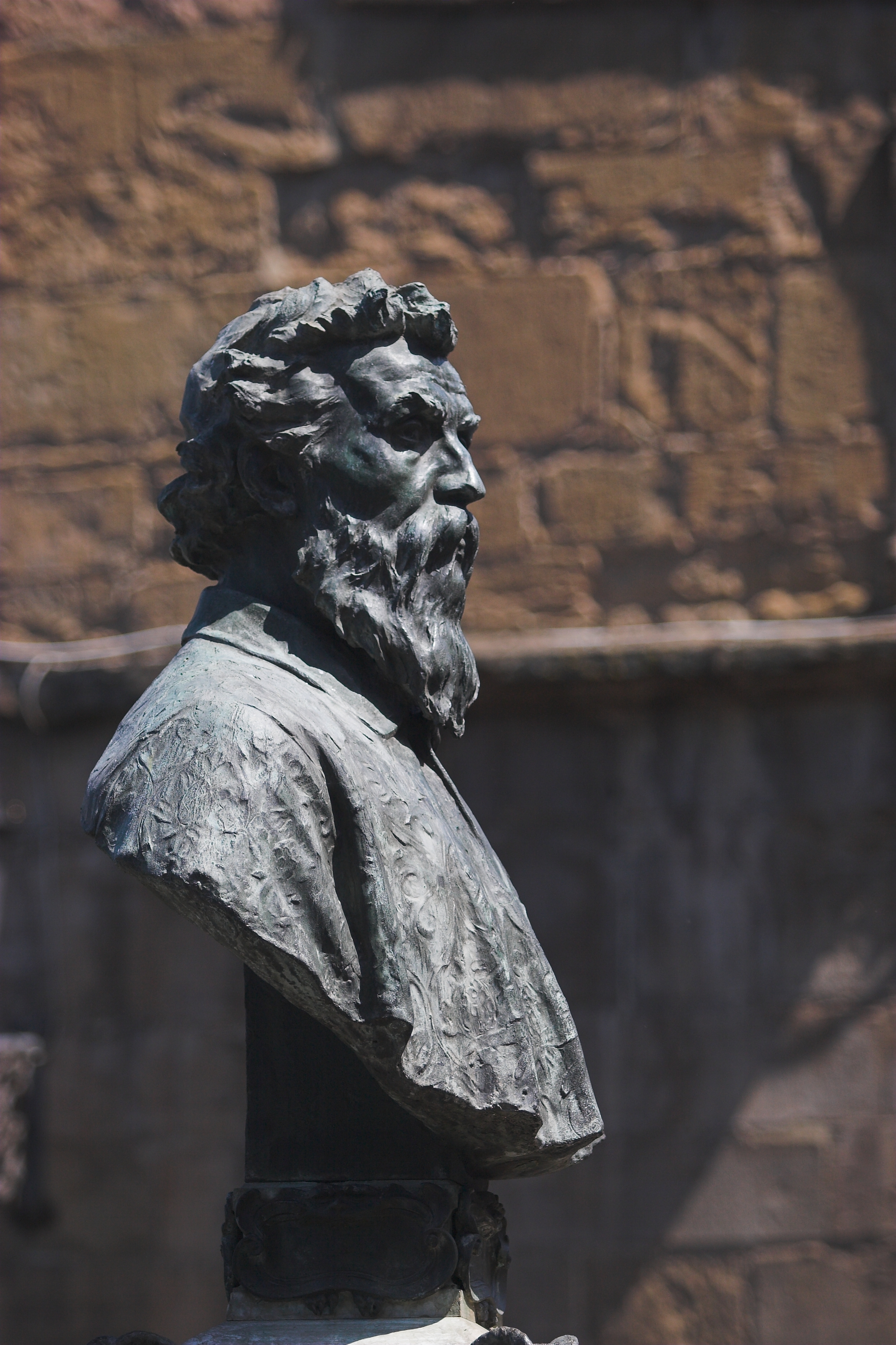
     Before I started the book, I knew that Cellini was a dastardly fellow, that he had murdered several people in his lifetime and bragged about it in his autobiography. I wanted to read this  because he was an artist during the late Renaissance and that is my art historical area of focus, so I knew that it would give me insights into how an artist lived and worked during the times. Now, I hope that some of the more salacious stories told are exclusive to Cellini. He brags about his artworks, not just describes them but lauds them (according to him, his artworks are better than any that came before and done in an entirely new way every time, even exceeding the ancients while mimicking them). He blames all his murders on self defense and the other person wronging him. He boasts about the praise given to him by his employers and other people and calls anyone who does not like him an evil fellow. All in all, he is a rather bad man, but his autobiography is an important historical document to a time long past and a rather interesting read because of all the crimes and angry outbursts.
    
     This book brings up the relationship between the patron and artist when artists were mere laborers. Cellini is often at the mercy of some powerful patron (pope, king, or rich person) much to his chagrin. For most of his life, he is not free to create what he wants. He has to create what the patron decides the subject matter should be and he never complains about it because that was the accepted method. After the subject matter is chosen, the artist is free to add his own style to it and this turns out to be very successful for Cellini according to his gloating. Numerous times, Cellini has to ask his patron if he can leave or travel, which is vastly different from the image of the wild and free artist of today. Cellini was definitely wild: he had a dangerous temper if crossed, but he was a social artist, wanting to please his patron at all times. This book highlights the different relationships and image of an artist from then to now, which allows for a comparison and for a more penetrating understanding.


Perseus with the Head of Med
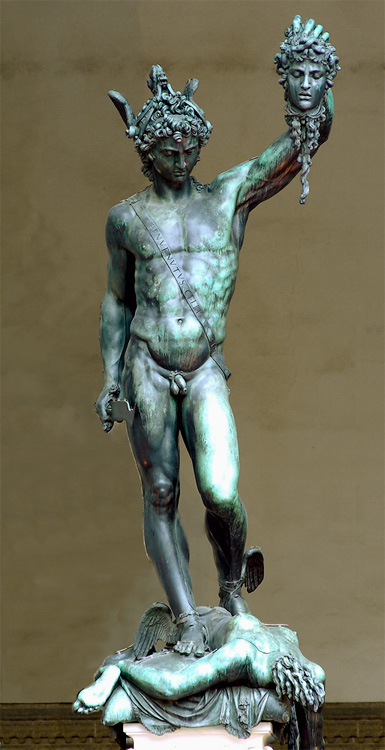
       Based on my own art historical research (I wrote my undergraduate thesis on competition between Leonardo and Michelangelo), the Renaissance was an atmosphere filled with rivalries. It is only really remarkable when you think of artistic relationships today. Yes, there are certain spiteful relationships, but most artists appreciate what others are doing. They do no try to tear each other down. During the Renaissance, they encouraged competition between competent artists and this could create a hostile atmosphere to create art, which is strange considering how beautiful and idealistic most of the art was (yes, there was monsters from mythology and depictions of Christ on the cross, but most of the people were depicted idealistically, choosing the best features and putting them all together).  There were less opportunities: fewer successful artists, fewer patrons, they all had to be formally trained and part of a guild before they could make money off of their art. This competitive nature may not apply solely to the Renaissance, but it is in definite contrast to what is going on now and a nice thought that we have partially put nasty rivalries behind us.

     This is also about memory and how it is subject to time. Not because Cellini was necessarily wrong in his recollections, biased, or trying to hide something, but because all memories are slanted and subject to change (he probably was trying to hide something or biased towards himself, though). Memories are not just recordings of what happened. They are re-remembered each instance, time plays tricks, and we are ever changing so even our opinions of our memories alter. No group of people will remember an event they were all at the same. Memory is a wonderful and fickle tool.
Salt Cellar
     Cellini is very famous for his autobiography and for what a rascal he was. The only artwork I remember of Cellini's is the salt cellar (which having a B.F.A. in Art History and focusing on the Renaissance it is impressive that I have never heard of any of his other artworks). That is a testament to his writing prowess and his storytelling capabilities. He did lead an interesting life with many adventures, fights, tribulations, travels, famous people, and powerful mortals. Besides the art historical, historical, and literary benefits, this autobiography reiterates that the past is a pope's treasure of life lessons. By learning from past people's mistakes, we can avoid them in our own lives and just expand our horizons.


All images taken from Wikipedia.