
Today, people in the United States celebrate the 4th of July typically with fireworks, cook outs, and drinks. This yearly celebration occurs on the day we announced our independence from Britain. In 1776, they marked this day with fireworks and we do the same today.
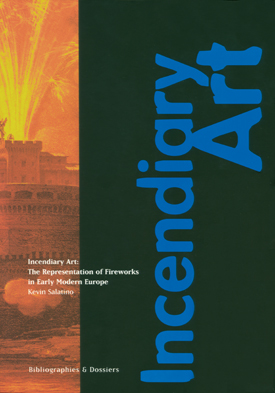
For this holiday I read a Getty Museum catalog called Incendiary Art: The Representation of Fireworks in Early Modern Europe by Kevin Salatino (this is a FREE ebook and you can check out some more from the Getty).
Fireworks are old, like 200 B.C. kind of old. Rumor has it the Chinese developed the first firework, but India also had them pretty early on, so its up in the air. The Chinese used the technology for weapons and rituals to keep away bad spirits, purely serious means. But sometime during the Middle Ages trade increased with China and Europe figured out how to make fireworks as well. Of course, they turned the pretty bangs of flowers into celebrations usually for weddings, births, victories, peace treaties, arrivals of important people, and even a king recovering health. They turned fireworks into a giant spectacle often involving actors and elaborate narratives (something we are seriously missing today). From the 15th to the 18th century these spectacles were part of Europe's celebrations, basically propaganda for the ruling party:
"It is a crucial commonplace that courtly festivities served above all to exalt the principals of monarchy and dynasty, to demonstrate power through expenditure, and the underline the fundamental distinction between the court and the rest of society."

The propaganda only reached a wider audience through prints and illustrations of these events sold to the public. These images were often twice removed from the actual event because they might be drawn ahead of time or copied from another artist.
Spectators often became part of the show as disaster stuck reigning down fire.

One eye witness from London named Horace Walpole writes:
"The rockets and whatever was thrown up into the air succeeded mighty well, but the wheels and all that was to compose the principle part, were pitiful and ill-conducted with no change of coloured fires and shapes: the illuminations was mean, and lighted so slowly that scarce anybody had patience to wait for the finishing; and then what contributed to the awkwardness of the whole, was the right pavilion catching, and being burned down in the middle of the show...Very little mischief was done, and but two persons were killed: at Paris there were forty killed, and near three hundred wounded, by a dispute between the French and Italians in the management, who quarreling for precedence in lighting the fires, both lighted at once and blew up the whole."
Just as often the audience appears bored by the fireworks. They have seen this sort of spectacle many times before.

But for all the danger and boredom, fireworks held a special place in society. In the 18th century one play-wright wrote a encyclopedia entry naming fireworks as art:
"In all the Arts it is necessary to paint. In the one that we call Spectacle, it is necessary to paint with actions."
This art served a purpose:
"A history of the early modern festival is a history of the frequently tense dialogue that characterized its negotiation between, among other things, the real and the fictive, the earthly and the celestial, urban space and sacred space, citizens and regent, city and empire. That these negotiations were often successful in alleviating that inherent tension is a testament to the power of artifice."
These events functioned on a political level: appeasing the citizens, showing of a monarch's grandeur, celebrating hard won victories.
Some daredevils went a little too far with the fireworks spectacle and their daring feats turned into cautionary morals:
"'He who climbs high has far to fall, and he who loves danger will die in danger.' Thus, the 'famous surgeon' Dr. Carl Bernoju 'in a display of recreational pyrotechnics as artistic as it was wanton,' transformed himself into a human firework by means of 'many firecrackers and small rockets tied to his body and limbs, even on all his fingers.'...Dr. Bernoju descended a long rope, engaging in acrobatics as he self-immolated ('looking more like a burning devil than a man'). The spectacle ended, of course, in disaster, as the print demonstrates in a continuous narrative technique in which the doctor is pictured twice–still attached to the rope at the beginning of the routine, and in a pool of fire and smoke and broken limbs on the pavement below."

This firework display served as a moral lesson to those who dared climb too high, to not be full of hubris.
Another moral extracted from fireworks is the reminder of death. Just like fireworks which reach high into the sky only to rain back to the earth extinguished, so too humans will eventually die:
"fireworks, whose brilliance so rapidly extinguished may here function as a kind of momento mori..."

But we in the U.S. would rather celebrate today with happiness and joy that we broke free and are known as a free country. Hopefully, today we can band together and enjoy a shared love of being American.

Throughout history fireworks have mesmerized, delighted, and even bored humans. Fireworks are part of those few moments in life where a person is present in that exact moment without having to force themselves to focus. Even if you've seen fireworks a thousand times, you still become mesmerized by the loud bangs, flashed of light and color, the shapes, and the ephemeral nature of the spectacle. There in a moment the next falling out of the sky. People watch waiting to see what shapes and color will appear as if by magic.
But we know it is science pure and simple advances in technology and understanding the world. Couple this day with a short explanation of the Chemistry of Fireworks.

No comments:
Post a Comment